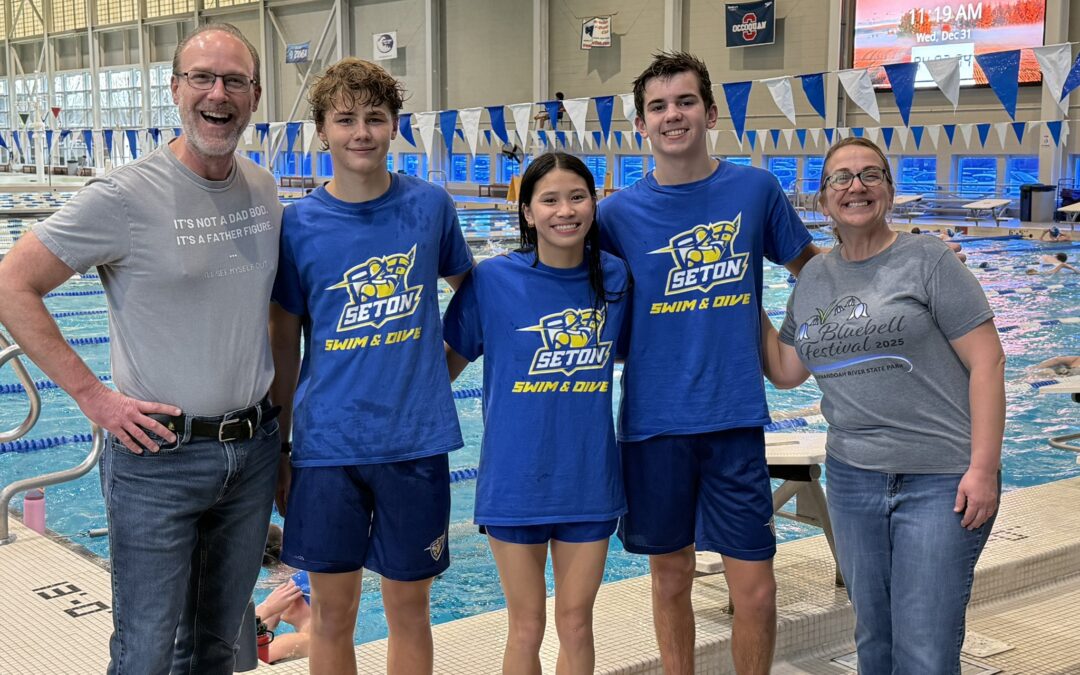
Top Finishers (L to R) Patrick Kay (10), Ariana Aldeguer (11), and Dominic Judge (11) with Event Hosts Robin and Sarah Given
Congratulations to Seton Swimming for completing our 14th Annual Cystic Fibrosis Children’s Miracle Network Swim-a-thon. 77 members of our team combined to raise $14,484 (as of January 31, 2026)! That means that we have now passed $124,000 in total fundraising for Cystic Fibrosis since we started this event on New Year’s Eve, 2012.
We also had 64 swimmers participate. An amazing 63 of them were able to complete the full 200 lengths of the pool!
To put that distance in perspective, it is the equivalent of:
- 5,000 yards
- Nearly 3 miles
- Ten (10) 500-yard freestyle events – in a row
- About 2/3rds of the way across the Chesapeake Bay
We kept the fundraising site up and running through January 15th so that each Fundraising Team has a chance to finish the job.
As of January 3, 2026, here are the team standings:

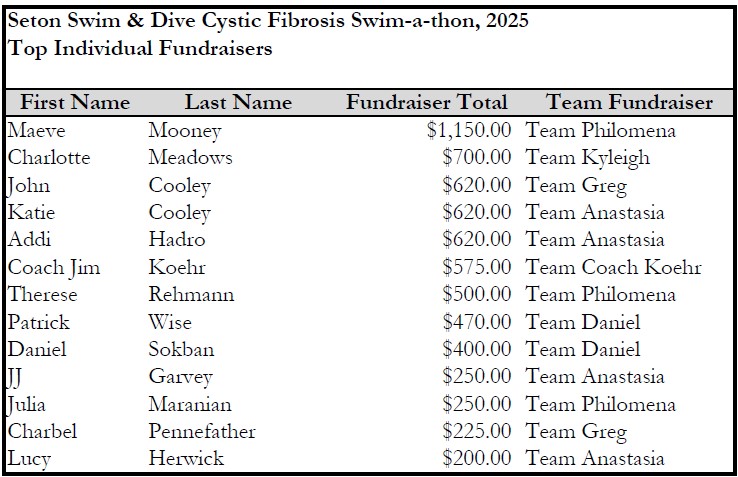
Here are the highest Individual Fundraising totals as of December 31, 2025. If your donor used your Team page and not your personal page, I have no way to know who specifically got the donation):
Life Lessons
Today’s swim was truly a great accomplishment for many of these swimmers, particularly some of the younger 6th and 7th graders. Aside from the great work we did on behalf of Cystic Fibrosis, I hope that many of us learned a valuable life lesson – We can always do more than we think we can do. I recalled a comment by former Seton Captain Meghan O’Malley who reminded me of something the Navy SEALS say: “When you think you are completely maxed out, you’ve reached 40% of your potential.”
This topic is so important to me that I chose to make it the subject of my Swimming Awards Banquet Speech in 2020: Swimming Awards 2020-Let’s Literally Astound Ourselves
We had an amazing number of Group 5 and 6 swimmers learn that lesson today. The list is too long to enumerate here, but I will highlight young 7th grader Patrick Wise (7). I have to wonder if he showed up to the event today believing that he was actually going to have to do the whole thing. But he refused to quit, and after only 2 hours and 47 minutes, he emerged from the water with what could have almost been called a smile
In addition to Patrick, I’d love to highlight Addi Hadro (8) who finished for the second year in a row. I was so pleased to see the leadership and sacrifice of Aoife Haggerty (11) and Ariana Aldeguer (11) who got in the water to swim with Addi for the last few hundred yards. That’s what I love to see from our older swimmers!
How about Blaise Hallada (8) and John Paul Hartung (9), both beginner swimmers who finished easily in 2:04 and 2:15, respectively. I only wish Coach Shane Koehr could have been there to see it!
One of the coolest scenes I experienced during the event was after Emma Magness (7) had to get out of the pool briefly when she got kicked in the face by accident. There was some question about whether she could finish (she did), but while we were discussing it, her little 7-year-old sister Ivanna Magness asked me, “Can I swim the rest for her?”
All I could say was “Suit up, let’s go!” And she did!
And finally, I can also highlight Maeve Mooney (6), Jane Vaughan (7), Evie Mayer (9), Camille Hallada (6), Colette Mikkelson (6), Siobhan Maher (8), Mark Hartung (7), Therese Rehmann (6), Oisin Haggerty (7) and so many others. They now know that they can do more than they thought they could, and I’m very proud of all of them.
The Big Reason We Swam Today
Let’s not forget the cause for which we all fought on a cold New Year’s Eve – the childhood disease, Cystic Fibrosis.
Former Seton Swim-Dad Robin Given started us off with a heart-felt talk about the impact of the advances in Cystic Fibrosis treatment on his family. With the help of Sarah Given, here is the long version of what he told us:
Cystic Fibrosis is an inherited disease that affects the lungs and digestive system of about 35,000 children and adults in the United States (70,000 worldwide). A defective gene causes the body to make a dysfunctional chloride channel leading to an abundance of thick sticky mucus accumulating in the body.
This mucus creates a host environment for bacteria leading to serious lung infections, scarring, and progressive loss of lung function. Respiratory failure has always been the biggest threat to people living with Cystic Fibrosis.
However, thick mucus also obstructs the pancreatic duct and prevents the body’s digestive enzymes from reaching the duodenum where they are needed to break down fats, proteins, and carbohydrates for absorption by the body.
Cystic Fibrosis was discovered and named in 1938 when many children weren’t living to see Kindergarten. Instead, they were succumbing to an unnamed familial illness. Early treatments were targeted at thinning the sticky mucus and treating lung infections. Children would be tipped side to side and head down and have their chest clapped on for hours a day by parents to loosen the thick mucus. Still, their longevity was not terribly improved.
30,000 people in the US are affected by Cystic Fibrosis, but this is a relatively low number compared to diseases like diabetes and cancer which affect far more people and therefore command more of the federally distributed research dollars – so CF families were on their own. In 1955 a group of parents and their friends came together to form the Cystic Fibrosis Foundation and started fundraising for a cure.
In 1989 Dr. Francis Collins, former head of the NIH, while working on the human genome project, discovered the gene for Cystic Fibrosis on the long arm of chromosome 7. This led to a deeper understanding and opened a new avenue for treatments.
Cystic Fibrosis is carried on a recessive gene, meaning both parents must be carriers to pass the illness to their children, and each child has a 1 in 4 chance of being born with CF. Cystic Fibrosis is widespread across the globe affecting nearly every ethnicity; however, it affects people of Northern European descent most often, with Ireland having more CF patients per capita than any other country, even today.
After the discovery of the CF gene, many new therapies were trialed but ultimately failed or only resulted in modest improvements. Each celebrated, each funded by donations from regular folks, but the longing for a cure remained.
Slowly, over the years since the birth of the Cystic Fibrosis Foundation, the median life expectancy has climbed. From 5 years in the 1950s, to 10 in the 1960s, to 20 in the 1980s, to 30 in the 1990s where it leveled off until 2013 and the advent of a new class of drugs called potentiator/ correctors. These medications work by creating a plug in the misfolded protein that puts it into the proper configuration for function.
In 2013, this new drug helped approximately 4% of the population who were enjoying incredible results. But the rest waited. Finally, in 2015, a new and improved potentiator/corrector called Trikafta was made available to 90% of the patients with the most common genetic combination of CF, and the results were tremendous!
Here is one incredible story to share from this year in the Cystic Fibrosis community:
A mother who didn’t have CF was carrying a child with CF and started taking Trikafta at 20-weeks of pregnancy when the baby in utero started and showing signs of echogenic bowel. This meant that the baby was at risk for developing an ileus at birth which would require emergency surgery. The baby’s bowel cleared, and the child was born with a normal bowel requiring no surgery.
This is a hopeful time for Cystic Fibrosis, where 94.6% of pregnancies were terminated when CF was discovered, new treatments are now available.
While work continues, the biggest news for the CF community was the widespread introduction of a new potentiator drug called Alyftrek. Potentiator drugs, or CFTR modulators, are designed to correct the malfunctioning protein produced by the genetic defect that lays at the heart of Cystic Fibrosis.
The benefits of Alyftrek are that it only needs to be taken once per day and it has shown greater benefits for some patients than previously developed CFTR modulators like Orkambi, Symdeco, Kalydeco, and TriKafta. This may seem underwhelming to some but imagine your therapy regimen went from three 30-minute chest physical therapy sessions along with several inhaled medications to simply taking one dose of medication once per day. Exciting and heady stuff for those patients that can take advantage of it.
Research continues into genetic therapies that could correct the base genetic defect at the DNA level. Approximately 10% of the CF population receives no benefit from existing CFTR modulator therapies. Development of new modulator therapies to serve this group continues. As well as research into new antibiotics and anti-inflammatory drugs.
Today, on the day of our swim-a-thon, the median life expectancy for people living with CF is 53! But it’s 53 for people who are 53 now. For younger people like those in our community, the sky is the limit, and their lives are expected to be rich and long!
This was made possible by donations from people like you, who did this work and gave this incredible gift to your friends.
There are a number of families close to the Seton community affected by Cystic Fibrosis and all of the life limiting challenges it imposes including the Given’s, the Kohlhaas’ and the Manley’s. The wonderful news is that scientists are closer than ever to a cure. The scientists we are supporting at the CF Foundation and Johns Hopkins University are studying new medications right now that hold the promise for a normal life for those who struggle with Cystic Fibrosis.
There is still no cure for Cystic Fibrosis and the new drugs work for about 90% of the CF population, meaning 10% of people with CF are still waiting for a medication that will work for them. Our work is not done.”
And that is why we swam today.
Great Swim-a-thon Performers
Congratulations to Ariana Aldeguer (JR) for finishing the full 5,000 yards in the fastest time of 1:08.00. She was closely followed by:
- Patrick Kay (10), 1:09.00
- Dominic Judge (11), 1:09.00
- Paul Partridge (8), 1:18.00
- Daniel Sokban (11), 1:20.00
- JJ Garvey (9), 1:20.00
- Philomena Kay (11), 1:21.00
- Maggie Schroer (10), 1:22.00
- Jack Herwick (10), 1:23.00
- Avila Mantooth (10), 1:24.00
- Betsy Arnold (10), 1:26.00
- Claire Kay (8), 1:26.00
- Luke Partridge (11), 1:27.00
- Anastasia Garvey (12), 1:28.00
- Will Judge (7), 1:29.00
- Michael Zahorchak (11), 1:29.00 (Remotely)
Here is a summary of the times for the entire group of 63 swimmers:
Cystic Fibrosis 2025 Swim-a-thon Finishers-v2
One last thing: Thank you to so many Seton Swimmers who hung around to the end to cheer for their teammates. I am very pleased to say that I saw more than I can possibly list here.
Remember the “S” in our GEMS? Sacrifice – We offer it up, we love all our teammates. This was a great example of the love of which we speak.
I’m very proud of what we accomplished today. Not only did we do some small part to help find a cure for Cystic Fibrosis, but many of us also learned a valuable life lesson: that we are capable of so much more than we think we are.
Great job Seton Swimming!
Coach Jim Koehr